








Heritage

Season 26
Types de médias
  • Photos
  • Vidéos
  • Sons
Années
  • 2026
  • 2024
  • 2023
  • 2022
  • 2021
  • 2020
  • 2019
  • 2018
  • 2017
  • 2016
  • 2015
  • 2014
Afficher les résultats (121)
supprimer tous les filtres
  • News
  • Gallery
  • Gitana 18
  • Team
  • Retractable Y-shaped foils, adjustable in three dimensions

    Inspired by the appendages of the America's Cup foiling monohulls, these Y-shaped foils have a wingspan of over 5 metres. They are designed to generate powerful lift, increase power and offer a wide range of adjustments to optimise flight at every point of sail and in all conditions. Beyond their impressive size, these foils feature many unique innovations.

    Revolutionary U-shaped rudders

    These are probably the most visually striking innovations on the new Maxi Edmond de Rothschild. To fly high above rough seas while maintaining control, the team wanted very long rudders that would remain in contact with the water. The challenge is that longer rudders tend to flex under load, severely affecting steering and the efficiency of their lifting surfaces. A new geometry was needed to give these appendages maximum stiffness, resist cavitation and ultimately improve control of the boat and make better use of its power. The result is a set of U-shaped rudders over 4 metres long, a metre longer than those on Gitana 17. Their shape, reminiscent of a tripod or an inverted π, is only the visible part of what makes them so distinctive.

    A daggerboard optimised to stabilise the boat and limit cavitation

    With its wide span, the daggerboard resembles an aircraft tail assembly, with two adjustable flaps: one on the vertical section and the other on the horizontal section, the distinctive “manta-ray wing”. On Gitana 18, the innovation is to position this wing behind the vertical part of the appendage, rather than directly beneath it, to minimise flow disturbance and cavitation.

    Gitana 18’s daggerboard

    Rig: adjustable spreaders to control mainsail power while sailing

    Gitana 18’s mast is 1.50 metres taller than its predecessor’s. The boom is also shorter, creating a more slender sail plan. The major innovation is a set of spreaders that can be adjusted while sailing to bend the mast fore and aft. Actuated by hydraulic rams, these spreaders can pivot through 35 degrees to adjust the bend in the middle of the mast. This unprecedented system allows the sailor to control mainsail power: adding depth in light winds to take off sooner, or flattening the sail to reduce power at high speed or in strong winds. Adjusting the depth, and therefore the power, of the mainsail can also save a solo sailor time and energy by reducing the need for risky manoeuvres or headsail changes.

    Central hull:
    an integrated, structural coachroof

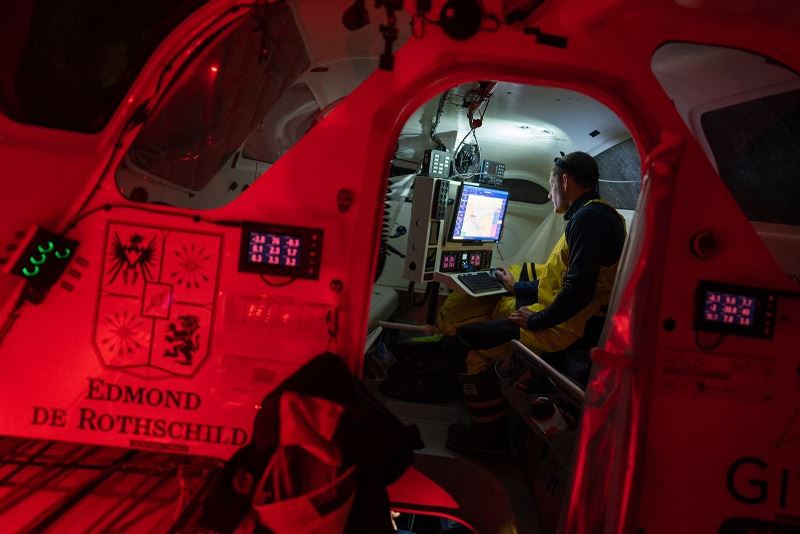
    The naval architects and Gitana design team wanted an exceptionally stiff, structurally robust platform. This applies both to the floats, which must withstand heavy loads from the foils and rudders, and to the central hull, which is subject to torsion. The enclosed coachroof is integrated into the hull and contributes to its structural strength. Inside, the cockpit brings all sail-handling controls together, with ergonomics shaped by many hours of design and development. The coachroof also stands out for the number and size of its windows. This configuration meets the visibility requirements of the Ultim class rules and gives sailors the best possible view to keep a visual watch.

    Gitana 18’s coachroof

    27.11.2020

    The Gitana Team interrupts its Jules Verne Trophy attempt.

    After three days at sea on their first round the world record attempt, Franck Cammas and Charles Caudrelier, in agreement with Cyril Dardashti, the director of the five-arrow racing stable, have this evening taken the decision to interrupt their record bid and return to their port of registry. This announcement comes as a result of damage that occu…

    par Gitana

    After three days at sea on their first round the world record attempt, Franck Cammas and Charles Caudrelier, in agreement with Cyril Dardashti, the director of the five-arrow racing stable, have this evening taken the decision to interrupt their record bid and return to their port of registry. This announcement comes as a result of damage that occurred when the boat collided with a UFO* yesterday, rendering it impossible for the crew to sail the Maxi Edmond de Rothschild at her full potential. Currently situated to the north of the Cape Verde archipelago, the sailors that make up Gitana Team are positioned some 1,900 miles from Lorient. Gitana 17 is now pointing her bows towards this destination.


    “The decision to turn back really hasn’t been an easy one to make. It was carefully thought out and all the different parties involved in the project were consulted and the crew made the decision. It is motivated by two elements: the incident that occurred yesterday and the technical consequences discovered this afternoon, together with the quality of the window we’ve enlisted in. Indeed, day after day, our weather observations are confirming that the South Atlantic will not be showing us her best side, with a Saint Helena High that is a long way south, forcing us not just to take a big detour around the outside but also to plunge deep into the south to round the Cape of Good Hope. Even though the routing is still giving us a passage within the record time, we know that such a feat would require us to be at our full potential, which unfortunately is no longer the case. Turning back today means we can quickly return to our technical base, effect the necessary repairs and then very quickly get back on standby ready to set sail again this winter to conquer the Jules Verne Trophy”,  concluded Cyril Dardashti. 


    When setting sail from Ushant in the early hours of Wednesday, the possibility of turning back was clearly mentioned  by Franck Cammas before leaving terra firma. Though the doubts of the co-skipper of the Maxi Edmond de Rothschild were more geared around the reliability of the weather window that his crew were preparing to take on, this scenario of breaking gear was also among the cases discussed within the team in the run-up to the departure. This is not an unprecedented situation in the Jules Verne Trophy, in fact it even forms an integral part of the history of the record! Ironically, on this exact same date some 4 years ago, the crew of Idec opted to turn back whilst it was making headway to the south of the doldrums following a deterioration in the weather window. However, this first aborted attempt did not prevent them from setting sail again nineteen days later and returning to Ushant on 26 January 2017, the record and an exceptional new reference time in the bag.


    Review of the damage

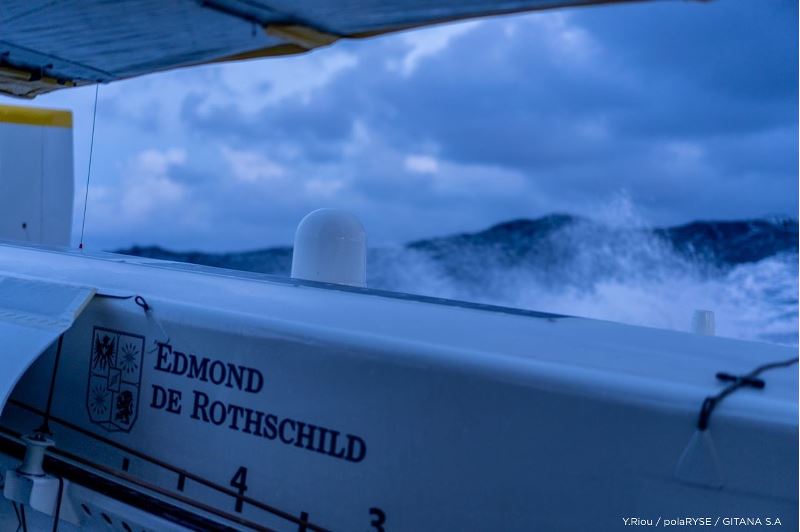
    26 November 14:00 UTC –   On Thursday afternoon, whilst slipping along downwind at over 30 knots between the Azores and Madeira, the Maxi Edmond de Rothschild hits a UFO (Unidentified Floating Object). The impact is violent, immediately causing the 32-metre giant to slow. Franck Cammas and Charles Caudrelier’s crew alerts the shore team and begins its  investigations. The effect of the impact on the rudder of the port float and more precisely its trim tab, has caused a piece of the steering system to break. David Boileau immediately switches back to his role of boat captain and quickly proceeds with the repair. After 1hr at a reduced pace, the latest addition to the Gitana fleet gets back out on the hunt for the record at high speed. Visually, the rudder blade is not damaged but the appendage proves to be hard to manipulate, which suggests there is damage to the system for raising and lowering the port rudder. For all that, a check is impossible as the area located at the end of the float is too exposed and too dangerous to venture out to. The Maxi Edmond de Rothschild continues her course towards the equator. 


    27 November 09:00 UTC –  To adjust their trajectory towards the equator, the men of Gitana put in several gybes. During the second, completed in the morning, when switching onto port tack, those on watch on deck notice that the port foil is also damaged and the evidence the crew discovers leave no room for doubt; they are the result of an impact, likely the same one suffered yesterday afternoon. Despite the crew being motivated to carry on, a series of exchanges throughout the day with their technical director, Pierre Tissier, and the manager of the design office, Sébastien Sainson, conclude that the appendage can be repaired at sea but the crew would no longer be able to use it at its full potential. 

    The Gitana Team wish the crew of Sodebo every success with their attempt.  

     
    *UFO: Unidentified floating object
    The crew of the Maxi Edmond de Rothschild:


    Franck Cammas and Charles Caudrelier, skippers
    David Boileau, trimmer bowmanErwan Israël, helm trimmer
    Morgan Lagravière, helm trimmer
    Yann Riou, trimmer mediaman

    Marcel van Triest, weather router
    Yann Eliès, replacement crew