








Heritage

Season 26
Types de médias
  • Photos
  • Vidéos
  • Sons
Années
  • 2026
  • 2024
  • 2023
  • 2022
  • 2021
  • 2020
  • 2019
  • 2018
  • 2017
  • 2016
  • 2015
  • 2014
Afficher les résultats (121)
supprimer tous les filtres
  • News
  • Gallery
  • Gitana 18
  • Team
  • Retractable Y-shaped foils, adjustable in three dimensions

    Inspired by the appendages of the America's Cup foiling monohulls, these Y-shaped foils have a wingspan of over 5 metres. They are designed to generate powerful lift, increase power and offer a wide range of adjustments to optimise flight at every point of sail and in all conditions. Beyond their impressive size, these foils feature many unique innovations.

    Revolutionary U-shaped rudders

    These are probably the most visually striking innovations on the new Maxi Edmond de Rothschild. To fly high above rough seas while maintaining control, the team wanted very long rudders that would remain in contact with the water. The challenge is that longer rudders tend to flex under load, severely affecting steering and the efficiency of their lifting surfaces. A new geometry was needed to give these appendages maximum stiffness, resist cavitation and ultimately improve control of the boat and make better use of its power. The result is a set of U-shaped rudders over 4 metres long, a metre longer than those on Gitana 17. Their shape, reminiscent of a tripod or an inverted π, is only the visible part of what makes them so distinctive.

    A daggerboard optimised to stabilise the boat and limit cavitation

    With its wide span, the daggerboard resembles an aircraft tail assembly, with two adjustable flaps: one on the vertical section and the other on the horizontal section, the distinctive “manta-ray wing”. On Gitana 18, the innovation is to position this wing behind the vertical part of the appendage, rather than directly beneath it, to minimise flow disturbance and cavitation.

    Gitana 18’s daggerboard

    Rig: adjustable spreaders to control mainsail power while sailing

    Gitana 18’s mast is 1.50 metres taller than its predecessor’s. The boom is also shorter, creating a more slender sail plan. The major innovation is a set of spreaders that can be adjusted while sailing to bend the mast fore and aft. Actuated by hydraulic rams, these spreaders can pivot through 35 degrees to adjust the bend in the middle of the mast. This unprecedented system allows the sailor to control mainsail power: adding depth in light winds to take off sooner, or flattening the sail to reduce power at high speed or in strong winds. Adjusting the depth, and therefore the power, of the mainsail can also save a solo sailor time and energy by reducing the need for risky manoeuvres or headsail changes.

    Central hull:
    an integrated, structural coachroof

    The naval architects and Gitana design team wanted an exceptionally stiff, structurally robust platform. This applies both to the floats, which must withstand heavy loads from the foils and rudders, and to the central hull, which is subject to torsion. The enclosed coachroof is integrated into the hull and contributes to its structural strength. Inside, the cockpit brings all sail-handling controls together, with ergonomics shaped by many hours of design and development. The coachroof also stands out for the number and size of its windows. This configuration meets the visibility requirements of the Ultim class rules and gives sailors the best possible view to keep a visual watch.

    Gitana 18’s coachroof

    22.01.2024

    The Kerguelen Islands astern.

    This fifteenth day at sea for Charles Caudrelier in the Arkea Ultim Challenge Brest has been punctuated by the rounding of the Kerguelen Islands, as well as a delightful encounter offshore of the French archipelago, which makes up one of the five administrative districts of the French Southern and Antarctic Lands (TAAF). At the latest ranking this…

    par Gitana

    This fifteenth day at sea for Charles Caudrelier in the Arkea Ultim Challenge Brest has been punctuated by the rounding of the Kerguelen Islands, as well as a delightful encounter offshore of the French archipelago, which makes up one of the five administrative districts of the French Southern and Antarctic Lands (TAAF). At the latest ranking this evening, the Maxi Edmond de Rothschild is continuing to go it alone in the Indian Ocean and now boasts a lead of more than 1,400 miles over closest rival, Thomas Coville.
    Magical austral encounter   

    Late in the evening in Europe, whilst the Maxi Edmond de Rothschild was powered up making over 30 knots at 51° South approaching the Kerguelen Islands, the skipper was contacted over VHF by a French fishing boat from SAPMER. The Mascareignes III is a longline fishing boat active in the Southern Ocean and it passed within a few boat lengths of the 32-metre giant. Aboard her, Niels Gins, a scientist and inspector from the French Southern and Antarctic Lands (TAAF), a major operator in the offshore racing domain and hence addicted to the cartography for the Arkea Ultim Challenge, immortalises the moment: Gitana 17 flying amongst the albatrosses!   “Being a sailor myself, it was an absolute pleasure to cross tacks with Gitana! I monitor the cartography every 2/3hrs, but I didn’t think she’d pass so close,” raved the young scientist.     
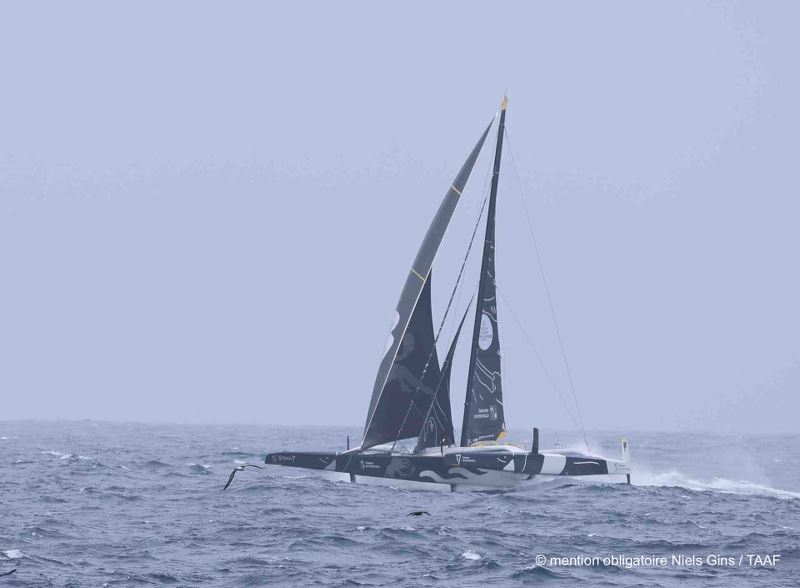
    On board every fishing vessel operating in the waters of the Austral Islands, a fisheries inspector, representing the prefect as the senior TAAF administrator, ensures that the regulatory measures are being applied and collects essential data for scientific monitoring of the fishery. As part of his duties, the inspector is also responsible for filming and photographing any marine fauna and shipping observed, including any illegal fishing vessels, in a bid to counter ‘pirate fishing’, as well as recording special or rare sightings, such as the passage of an ocean-racing yacht.     

    Thank you to Niels Gins, to the crew of the Mascareignes III and to the TAAF’s Fisheries Department for this lovely gift from the Deep South.     
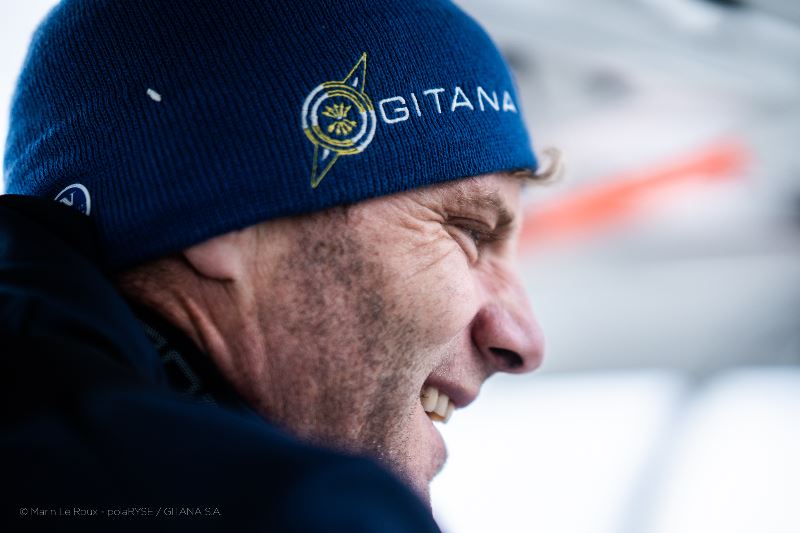
    Charles Caudrelier, on 22 January 

    “It was fantastic to come across the fishing boat this morning offshore of Kerguelen and have a chat with them, even though I was fairly focused on getting my boat making headway as it was mid-gybe for us, close to the Kerguelen cetacean exclusion zone.   I’ve been in the Southern Ocean for three days now and I’m gradually getting into the swing of it. My race has inevitably changed since Tom (Laperche, editor’s note) came to a stop, but ultimately it’s pretty exhilarating, even if it’s quite special now. I’ve gone from spending all my time getting the boat making faster headway than the others around the world, where every mile counted, to trying to limit my speed to 35 knots and come up with solutions to go where the seas aren’t so heavy. I’m prepared to lose 150 miles in the process… My lead helps me manage my race, whilst preserving the boat as much as possible. That’s really the biggest challenge of all and I’m proud to have managed to find this mode in me as this is the right one for now. I’m in an easier phase at the moment because I’m at the head of the race, so I can only be in good spirits. On top of that, sea conditions are easy for now and time isn’t dragging yet. There are some lengthy passages, but I’m not getting bored. As soon as I find the time, either I sleep, I do some odd jobs on the boat, I check everything, I tidy up or I clean.   I’ve begun listening to one or two podcasts, but I find it hard to get my head out of the race as I’m really immersed in it…”   

    Ranking at the 18:00 UTC position report     

     1) Maxi Edmond de Rothschild – Charles Caudrelier 
     2) Sodebo Ultim 3 – Thomas Coville – 1,437.2 miles behind the leader   
    3) SVR Lazartigue – Tom Laperche – 2,554.1 miles behind the leader  (victim of serious damage, newly arrived in Cape Town) 
    4) Maxi Banque Populaire XI – Armel Le Cleac’h – 2,655.5 miles behind the leader   
    5) Actual Ultim 3 – Anthony Marchand – 2,690.8 miles behind the leader     
    6) Ultim Adagio – Eric Peron – 4,168.1 miles behind the leader