








Heritage

Season 26
Types de médias
  • Photos
  • Vidéos
  • Sons
Années
  • 2026
  • 2024
  • 2023
  • 2022
  • 2021
  • 2020
  • 2019
  • 2018
  • 2017
  • 2016
  • 2015
  • 2014
Afficher les résultats (121)
supprimer tous les filtres
  • News
  • Gallery
  • Gitana 18
  • Team
  • Retractable Y-shaped foils, adjustable in three dimensions

    Inspired by the appendages of the America's Cup foiling monohulls, these Y-shaped foils have a wingspan of over 5 metres. They are designed to generate powerful lift, increase power and offer a wide range of adjustments to optimise flight at every point of sail and in all conditions. Beyond their impressive size, these foils feature many unique innovations.

    Revolutionary U-shaped rudders

    These are probably the most visually striking innovations on the new Maxi Edmond de Rothschild. To fly high above rough seas while maintaining control, the team wanted very long rudders that would remain in contact with the water. The challenge is that longer rudders tend to flex under load, severely affecting steering and the efficiency of their lifting surfaces. A new geometry was needed to give these appendages maximum stiffness, resist cavitation and ultimately improve control of the boat and make better use of its power. The result is a set of U-shaped rudders over 4 metres long, a metre longer than those on Gitana 17. Their shape, reminiscent of a tripod or an inverted π, is only the visible part of what makes them so distinctive.

    A daggerboard optimised to stabilise the boat and limit cavitation

    With its wide span, the daggerboard resembles an aircraft tail assembly, with two adjustable flaps: one on the vertical section and the other on the horizontal section, the distinctive “manta-ray wing”. On Gitana 18, the innovation is to position this wing behind the vertical part of the appendage, rather than directly beneath it, to minimise flow disturbance and cavitation.

    Gitana 18’s daggerboard

    Rig: adjustable spreaders to control mainsail power while sailing

    Gitana 18’s mast is 1.50 metres taller than its predecessor’s. The boom is also shorter, creating a more slender sail plan. The major innovation is a set of spreaders that can be adjusted while sailing to bend the mast fore and aft. Actuated by hydraulic rams, these spreaders can pivot through 35 degrees to adjust the bend in the middle of the mast. This unprecedented system allows the sailor to control mainsail power: adding depth in light winds to take off sooner, or flattening the sail to reduce power at high speed or in strong winds. Adjusting the depth, and therefore the power, of the mainsail can also save a solo sailor time and energy by reducing the need for risky manoeuvres or headsail changes.

    Central hull:
    an integrated, structural coachroof

    The naval architects and Gitana design team wanted an exceptionally stiff, structurally robust platform. This applies both to the floats, which must withstand heavy loads from the foils and rudders, and to the central hull, which is subject to torsion. The enclosed coachroof is integrated into the hull and contributes to its structural strength. Inside, the cockpit brings all sail-handling controls together, with ergonomics shaped by many hours of design and development. The coachroof also stands out for the number and size of its windows. This configuration meets the visibility requirements of the Ultim class rules and gives sailors the best possible view to keep a visual watch.

    Gitana 18’s coachroof

    29.10.2018

    The latest generation Maxis: giant and flying!.

    Since 2010, gigantic proportions have made their grand comeback in the Route du Rhum. Indeed, the 9th edition of the famous transatlantic race between Saint Malo and Pointe-à-Pitre was punctuated by Franck Cammas’ crushing victory. At the helm of his Groupama 3 built for crewed configuration, and freshly crowned in the Jules Verne Trophy, the sailo…

    par Gitana

    Since 2010, gigantic proportions have made their grand comeback in the Route du Rhum. Indeed, the 9th edition of the famous transatlantic race between Saint Malo and Pointe-à-Pitre was punctuated by Franck Cammas’ crushing victory. At the helm of his Groupama 3 built for crewed configuration, and freshly crowned in the Jules Verne Trophy, the sailor from Aix en Provence paved the way forward for the new maxi-multihulls. In this way, in 2014, Spindrift, the largest trimaran ever built, took the start and ultimately finished in 2nd place. This year, for the race’s 40th anniversary, six giants will battle it out. All of them, with the exception of Remade Use it Again! must wait for the big day outside the historic basins of Saint Malo due to their extraordinary dimensions. And when you know that the beam determines a vessel’s strength, it’s evident that there will be a battle royal on the cards!
    VIDEO – But where is the Maxi Edmond de Rothschild?

    Sébastien Josse and the latest addition to the Gitana fleet are much yearned for on the pontoons of Saint Malo, even though their late arrival has been scheduled for a good while. Jacques Caraës, Race Director of the Route du Rhum – Destination Guadeloupe gives us the low-down in the first article, “98 seconds” created by Yann Riou and Eloi Stichelbaut.


    Having left her base in Lorient this Monday at noon, the Maxi Edmond de Rothschild is expected in Saint Malo tomorrow morning Tuesday 30 October.

    The Ultimes, outstanding… and outside the basins in Saint Malo

    Measuring 32 metres long and 23 metres wide, not including the various parts of the floats around the appendages, the Naye lock gates which herald the compulsory entry to the basins of the pirate city simply aren’t wide enough to envisage getting five of the six competitors through with the optimum level of safety.  In this way, Edmond de Rothschild will be moored at the foot of the ramparts, albeit beside the Bourse harbour station.
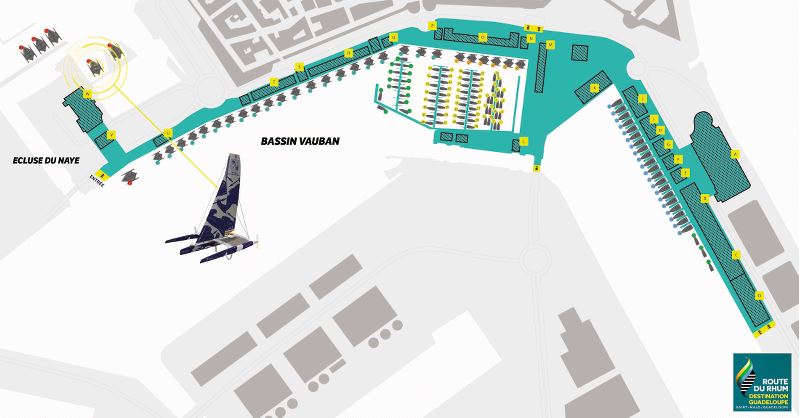
     

    The anecdote is far from just a logical one either, as these XXL problems demonstrate that these giants of the seas have well and truly made the switch to a whole new era. Indeed, what determines the power of a trimaran and, as a result, the difficulty of helming her singlehanded, is her wide beam. In fact, it’s worth noting that during the last edition, solely two boats had to moor outside the Bassin Vauban.

    Crossing the Atlantic singlehanded on a latest generation Ultime… it’s today already!

    With its record number of participants – 123 in all the classes combined – the Route du Rhum 2018 is already shaping up to be a red-letter edition. In the star class of Ultimes, there could be a lot more in this vintage and rumour has it that it is quite simply a turning point in offshore racing. Not only are the flying maxi-multihulls making their entry on the solo stage, among them the pioneering Maxi Edmond de Rothschild, but it is also the first confrontation on an oceanic scale for these latest generation chargers, which further down the line are destined to rip shreds out of the time it takes to circumnavigate the globe.

    However, behind the technological wizardry and the remarkable work by the teams to fine-tune these extremely demanding, cutting-edge giants of the seas, the human exploit remains and maybe takes an even more key role on such machines. Indeed, driving a carbon monster, singlehanded at the sustained rhythm of a transatlantic, that is capable of literally freeing itself of the water, is a challenge of rare intensity… It is a gamble – and a crazy one at that – which three of the six entries in the Ultime category are preparing to go for: Sébastien Josse, skipper of the five-arrow team, as well as Armel Le Cléac’h and François Gabart, who certainly don’t have the latest generation crafts designed specially to fly, but who have managed to adapt their steeds with this aim in mind. On 4 November 2018, this trio is setting sail to write the first lines in the offshore flying boat story. Through her philosophy and her architectural concept, the Maxi Edmond de Rothschild is doubtless the boldest and the most innovative of them all.