








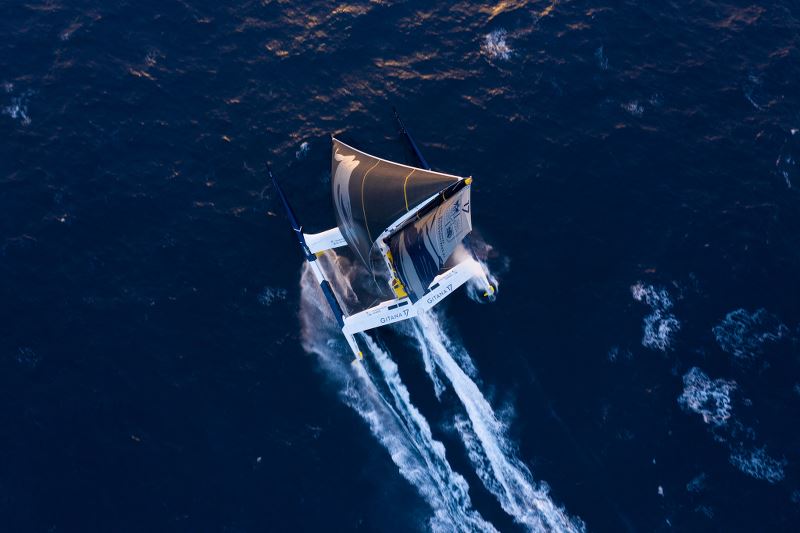
Breakage is not compatible with safety or performance
“Our decision to abandon our attempt is a result of breaking the rudder stock on the starboard float”, Pierre Tissier reminds us. “It’s still too early to explain the exact reasons for this damage, even though we have had a lot of discussions with the crew and are able to substantiate certain hypotheses. However, access to the area in question is very difficult as the rudder system is too exposed on the boat’s aft section, meaning that lengthy investigations are not possible as yet. This is why envisaging carrying a spare part to make a replacement at sea is totally out of the question”, added the technical director of the five-arrow racing stable.
In fact, the question about a spare part has been raised on several occasions following the announcement of the team’s abandon. As such, it’s important to respond to this issue: “It’s worth noting that a rudder weighs around 200 kg and assembling or dismantling such a part requires a special procedure, up to three people and a support rib, and that is when the boat’s in a port and without heavy seas… Offshore, the crew does not have the necessary tooling and, above all, it is not able to access the area in question, which is a long way aft and is protected by the rudder ‘chimneys’”, explained Sébastien Sainson, the director of Gitana’s design office.
This damage forced Franck Cammas, Charles Caudrelier and their four crew to reluctantly interrupt a record attempt that was in full flight and looked very promising in terms of the upcoming weather… However, plunging down into the Southern Ocean, far from habitation and out of reach of any rapid emergency assistance leaves no room for approximation. At a latitude of 50° south, bordering on a zone prone to ice, the crew has to be able to be autonomous and in control of its trajectory under all circumstances.
“The Maxi Edmond de Rothschild is equipped with lifting float rudders, which is fortunate because since the damage occurred, the crew has been able to sail almost normally with the rudder raised. In practical terms, had this damage occurred further down the track in our round the world, we may have looked at things differently, however in our case, it’s the safety aspect that prevailed. We’d only just entered the Southern Ocean. We were unable to use one of our float rudders, which meant that the only way to steer the boat was by using the other float rudder and the central rudder” explained Pierre Tissier, with Sébastien Sainson providing more light on the subject: “Thanks to the experience we’ve gained and the numerous miles the Maxi has now covered, we’ve noticed that the central rudder is more exposed to impact than before, which must be down to the addition of the elevators. As a result, there’s an added risk of ending up with two damaged rudders and a boat that is impossible to steer in some of the remotest areas of the globe. It simply wasn’t reasonable and therefore it was unthinkable to proceed.”
Last but not least, there was the issue of performance. Taking on a speed record involves knowing what goal you want to achieve before you set sail. Given the exceptional time of 40 days 23 hours and 30 minutes recorded by Francis Joyon and his men, the moment we crossed the start line on 10 January offshore of Ushant, the sailors on the Maxi Edmond de Rothschild knew that there was no room for error. “If you were to put the safety issue in the Southern Ocean to one side, which obviously is not feasible in the real world, this breakage is a genuine handicap when the boat is sailing on port tack. We reckon that you lose around 20% of the boat’s potential. In the south, where the point of sail is predominantly off the wind, this would inevitably have had a major impact, but during a beat, which involves sailing close-hauled, or on a reach, we envisage that the speeds would have been even worse, except on starboard tack of course (namely pressed down on its port float and appendages) where the boat is intact. It’s tough, but that’s the nature of record attempts and the Jules Verne Trophy”, concluded Cyril Dardashti.
Hats off to Boris Herrmann
Just hours away now from the much-awaited denouement of the Vendée Globe, the present scenario is completely unprecedented with eight sailors grouped together within 500 miles. Added to that, a series of time bonuses are yet to be awarded, which should reshuffle the cards for the final podium, and for once this will likely differ from the line honours. At this historic moment, Gitana Team’s thoughts go out to Boris Herrmann. The German sailor, who is attacking his last night at sea in the top trio is the surprise of this 2020-2021 edition. He has sailed a masterful race aboard the Imoca Malizia Sea Explorer and has been proudly flying the flag of the Yacht Club de Monaco during this action-packed round the world. The 60-footer is none other than the former Mono60 Edmond de Rothschild, which the racing stable competed on in the race’s 2016 edition and it is a great source of pleasure to see one of the team’s former steeds performing so well. The final ranking will be revealed tomorrow offshore of Les Sables d’Olonne.

Jules Verne Trophy Info
At the latitude of Luderitz in southern Namibia
Speed: 24.6 knots
Course: 135°
Numbers to note:
– Passage across the line: 10 January 2021 at 01h 33′ 46” UTC
– Passage of the equator: 15 January 2021 at 14h 48’ 32’’ UTC, in 5 days 13 hours 14 minutes and 46 seconds
– Passage of the Cape of Good Hope: 21 January 2021 at 11h27’46’’ UTC, in 11 days 9 hours and 53 minutes (new reference time)
David Boileau, trimmer bowman
Erwan Israël, helm trimmer
Morgan Lagravière, helm trimmer
Yann Riou, trimmer media man
Marcel van Triest, weather router
Yann Eliès, replacement crew