








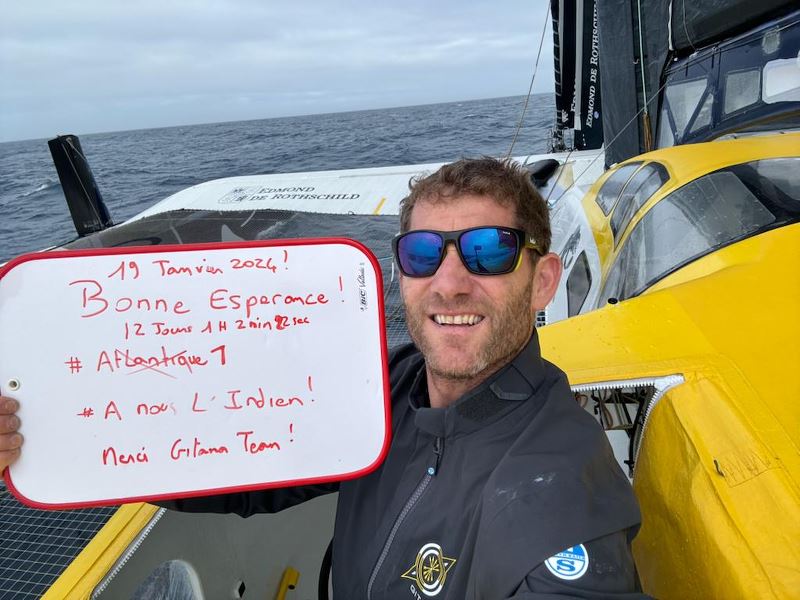
12 days to Good Hope, close to the reference times
Almost three years ago to the day, the Maxi Edmond de Rothschild and her six crew were competing in a Jules Verne Trophy record attempt (the outright round the world record under sail, editor’s note) and rounded this same cape after 11 days 9 hours and 53 minutes at sea. In so doing, Charles Caudrelier, Franck Cammas and their men treated themselves to the fastest ever reference time to the tip of South Africa and dedicated it to the boat’s owner, Baron Benjamin de Rothschild, who had passed away a few days earlier.
This Friday 19 January 2024, with a stellar passage time of 12 days 1 hour 14 minutes, Charles Caudrelier has not managed to beat this record. This was never the objective of course, but the time he has posted here remains impressive given that he didn’t choose the weather window for the start and his passage time across the North Atlantic took more than 6 days. Indeed, it speaks volumes about the intensity and commitment called for on this first quarter of the course.
The skipper of the Maxi Edmond de Rothschild boasts a clear lead at this first cape in the round the world Arkea Ultim Challenge – Brest, nearly 940 miles ahead of Thomas Coville, now 2nd. Meantime, Tom Laperche, whose trimaran SVR-Lazartigue suffered serious damage yesterday morning following a collision, is making for Cape Town in South Africa. “For 10 days, Tom was an admirable and formidable rival and he and Charles put on a fabulous top-flight duel during the descent of the Atlantic. As such, we wish him and his teams the very best of luck over the coming days and we hope to see him back out on the water again as soon as possible,”admitted Cyril Dardashti, director of the Gitana racing stable.
Deeply affected by yesterday’s news of this damage, Charles Caudrelier had this to say:
“Since the start, I’ve been living and breathing this adventure with Tom Laperche, slugging it out together. Last night he suffered a collision and that’s something you have no control over. Naturally, my first thought is one of sadness for Tom, for his teams. We’ve exchanged ideas and chatted a great deal. We also gently teased each other a lot about one another’s performance… There are 25 years between us. We’ve known each other for a fair few years and I really like the guy. This latest turn of events inevitably affects the way I’m sailing, as we were really in race mode, pushing hard… However, I think that the change of course zone was going to make each of us retreat into our shells again to focus on managing our boat.”
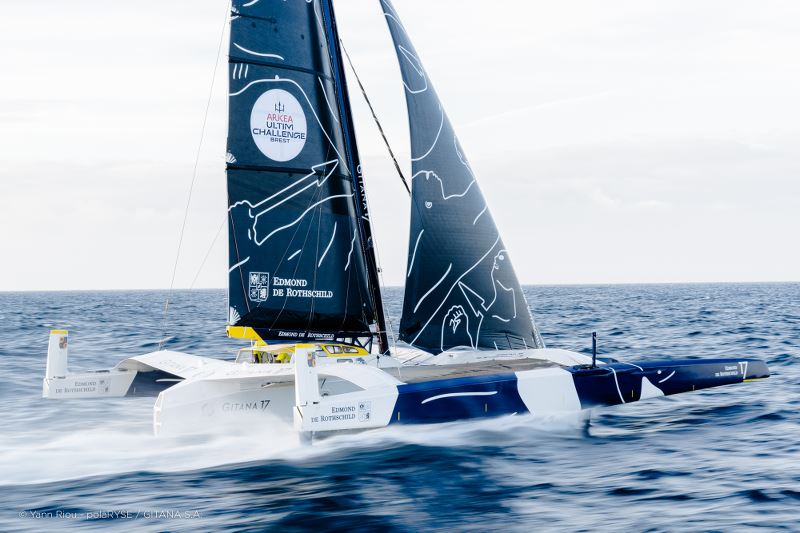
Southern Ocean ahoy
Two hours later, the five-arrow giant left another cape in her wake. Less renowned than its neighbour, the Agulhas Cape, some 80 nautical miles away, actually represents the true gateway to the Southern Ocean, since it is at this particular latitude that the Atlantic Ocean ends and the Indian Ocean begins.
“I couldn’t have dreamt of a better way to start the Round the World. It’s very satisfying to be the first into the Southern Ocean. It’s a fine objective achieved and an unquestionable advantage. Getting to this point with a boat in good condition and out in front is something I’m very proud of.
The passage around the Cape of Good Hope is always a special moment. It’s the gateway to the Southern Ocean and it marks the end of the Atlantic, so it’s a good chunk of course completed. We’re eager to return to the Atlantic too… but this time we’ll enter it from the other side,” explained the skipper of the Maxi Edmond de Rothschild, before giving us an insight into the scenario planned for the coming days. “Everything around me is grey with low visibility: the deep south vibes are really starting to kick in. The sea is still very gentle. I’m lucky to be ahead of a storm, so the seas aren’t too heavy – around 3 m – I just have breeze and that’s perfect.
I’m beginning my tour of Antarctica where we’ll be close to the ice zone. Over the first section of the Indian Ocean we should be sailing fairly far north as the ice gates are quite high. I don’t think the water will be below 10, 12°, maybe 7-8° at one point, but that’s okay. For now though, the programme for the Indian Ocean is pretty good considering where we are, which is quite incredible. We are set to pass below a zone of high pressure, which is quite rare. More often than not it’s a depression, so we’ll make the most of it. At least half of it is fairly mild for me and the Maxi Edmond de Rothschild. It’s not perfect. There are better weather scenarios where you can sail a straight-line course. Here, the ice zone will hinder us a bit. We’ll have to slalom our way around because that’s where things get breezy, but we’re happy it’s there as we have no desire to go and see the icebergs.”
Ranking on Friday 19 January at the 16:00 UTC position report
1)
Maxi Edmond de Rothschild – Charles Caudrelier
2) Sodebo Ultim 3 – Thomas Coville – at 936,1 miles of the leader
3) SVR Lazartigue – Tom Laperche – at 1 017,7 miles of the leader (victim of major damage on Thursday morning and en route to Cape Town in South Africa)
4) Actual Ultim 3 – Anthony Marchand – at 2 402,6 miles of the leader
5) Maxi Banque Populaire XI – Armel Le Cléac’h – at 2 410,6 miles of the leader
6) Ultim Adagio – Eric Peron – at 3 438,3 miles of the leader