








A gybing corridor
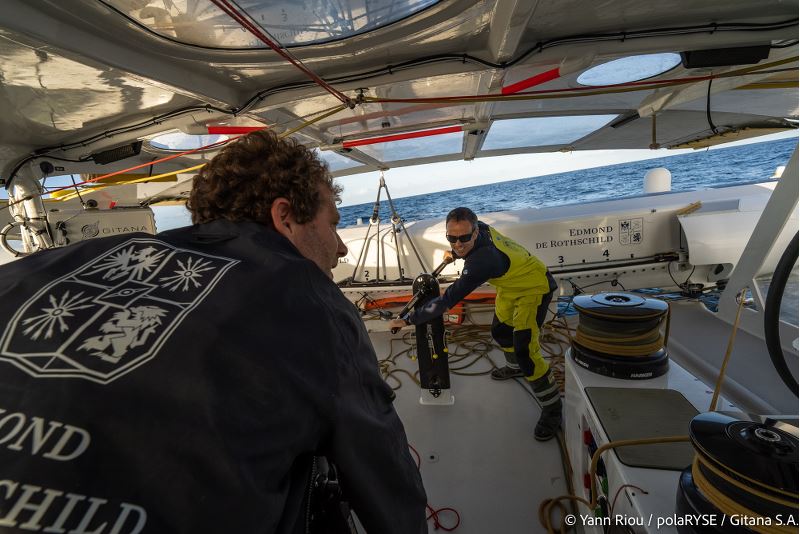
Since Tuesday afternoon and the start of their negotiation of the north-west tip of Spain, the duo on the Maxi Edmond de Rothschild and their Ultime rivals are linking together manoeuvres and sparing no effort in a bid to remain in a steadier corridor of breeze stretching out towards the south-west. In 48 hours’ time, Franck Cammas and Charles Caudrelier have put in no less than eighteen gybes! An impressive figure for anyone who’s previously sailed aboard the Verdier design, given how much physical effort is required, but it just goes to show how committed and motivated the men of Gitana Team are at the head of the race. “Franck and Charles are very focused and have been sailing a very clean race since the start. We’re hunting down the slightest rotation in the breeze and there’s plenty to keep an eye on at the moment, both on shore and at sea, due to the significant cloud cover. We’ve really had to be on top of our game to make the most of the corridor of breeze and hold onto the maximum pressure, a feat they’ve managed to perfection”, admitted Erwan Israël, one of the men that makes up the Maxi Edmond de Rothschild’s routing trio.
All out west
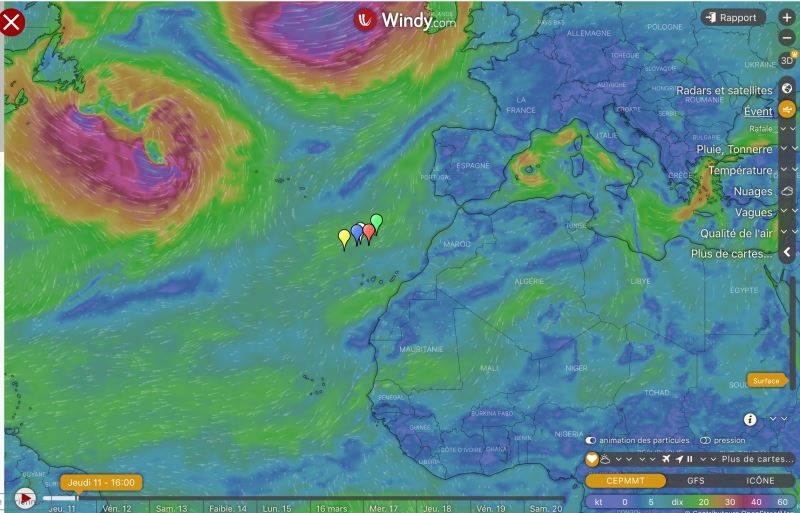
The descent of the North Atlantic has a succession of islands strewn across it: Madeira, the Canaries, Cape Verde. Though these names conjure up images of sunny destinations, for the sailors and their weather cell, they are primarily synonymous with wind shadows and the associated stalling. In addition to the weather conditions that naturally colour play in the area, it is these islands, some of which culminate at over 3,718 metres (Teide, in the Canaries) and their effects, which must be taken into account when deciding which strategy and trajectory to adopt over this section of the race: “Today, the aim is to distance ourselves from the Madeira archipelago so as not to be affected by the wind shadow created by its islands. We’re looking at the satellite photos of the disturbances over a 100 miles to the south-west. The same is true for the Canaries, which we’re targeting tonight. We’ve noted that the whole Ultime fleet has followed suit”, explained Erwan Israël, before giving us the low-down on the upcoming conditions: “The overall situation is still the same. We have a major low pressure system in the North Atlantic positioned quite far south. This low pressure is disrupting and pushing back the zone of high pressure eastwards, which has the effect of breaking up the trade wind system. We made the most of what we refer to as the Portuguese trades along the Iberian peninsula to make headway at a good pace, but unfortunately the NE’ly trade wind in the northern hemisphere has not established itself and is set to be light for the coming days. We’re going to have to be opportunistic, as we have since the start, and adapt to the evolution in the weather models.”
A new hierarchy
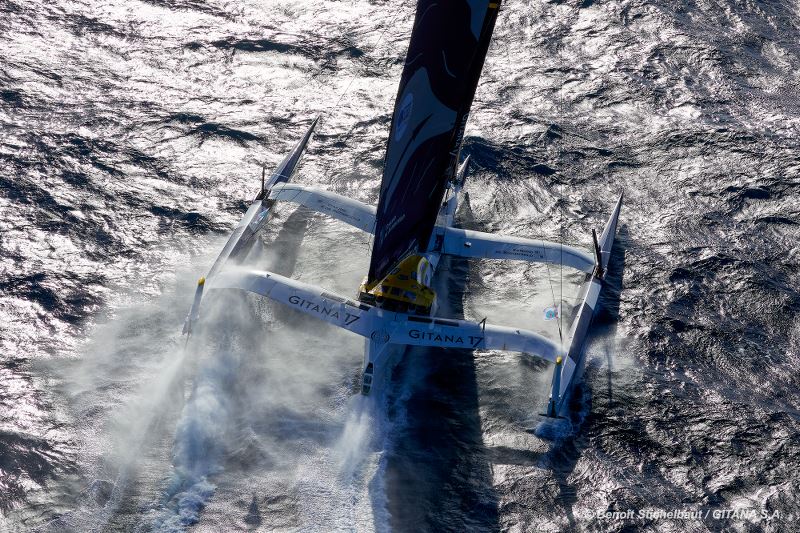
Heading the fleet since the first few minutes out on the racetrack, Franck Cammas and Charles Caudrelier were dominating play as far as the north-west tip of Brittany, where the breeze completely dropped away on Sunday night through into Monday, reshuffling the cards in the process. In the erratic winds and the meteorological brainteaser, there was constant jockeying for position at the front of the pack throughout the passage across the Bay of Biscay. By opting for an E’ly trajectory, accompanied by SVR-Lazartigue, the skippers of Gitana 17 came out on top as they tackled the passage around Cape Finisterre. In a beefier breeze, the Maxi Edmond de Rothschild and her crew showed just what they were made of, snatching back the lead on Tuesday evening; a position which the Caudrelier-Cammas duo are still holding onto this Thursday.
Astern of them, the hierarchy has been shaken up in more ways than one. Last night, Sodebo, which was lying in second place at the time, unfortunately damaged her starboard foil after colliding with a UFO. Since then, the two skippers have been in slo-mo and we’re still awaiting more information in the hope that they’ll very swiftly be able to get back out on the racetrack. SVR-Lazartigue has made the most of the situation to slip into the runner-up spot, whilst Banque Populaire XI has entered the top 3. Fourth placed Actual isn’t far off the pace and there is still precious little separating the Ultimes at the start of this race.
Images from the ocean, day 4 – abeam of Madeira
This Thursday morning, after four days at sea, the head of the Transat Jacques Vabre fleet is passing the Portuguese archipelago of Madeira. In the lead for more than 24 hours, Franck Cammas and Charles Caudrelier have spared no effort in getting the five-arrow maxi-trimaran making headway and making the most of the corridor of breeze ahead of the bows of the 32-metre giant. They’re reaping the rewards now, slipping along with a beautiful sunrise to boot: “We’ve got around fifteen knots and we’re making more than 30 knots, we’re flying…!” assures Franck Cammas from the cockpit of the Maxi Edmond de Rothschild.