








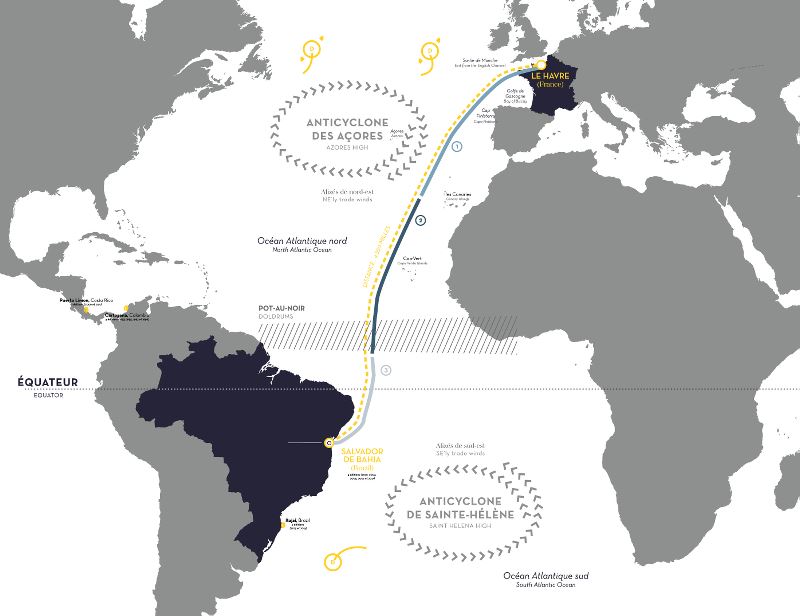
Weather, three 72hr stages
With some 4 days until the start, Sébastien Josse, skipper of the Maxi Edmond de Rothschild, gives us his analysis of the weather for the race; a course which he is dividing up into three ‘stages’, each of which he reckons today will take 72 hours. Naturally these figures remain theoretical and, as always, they will depend on the weather conditions encountered by the sailors along the way.
1 – From the start to the Canaries
“This first third of the course equates to around 1,400 miles and is the most intense and most strategic section of the race due to a combination of several factors. Already, there’s the stress of the start, where in a matter of minutes you have to switch to being at sea and lose the reflexes of a landlubber so as to find your sea-legs and get into the game as quickly as possible. The exit from the English Channel is a funnel with no way out, packed with shipping. Keeping watch is crucial and depending on the wind direction (if the start coincides with the arrival of a string of Atlantic lows for example), a high number of manœuvres may be required to power out to the north-west tip of Brittany. From here, the position of the Azores High will determine our trajectory towards the trade winds. The advantage with multihulls, and our big boats all the more, is that the speeds achievable enable us to outrun the weather systems rather than having to endure them, which is often the case for the other classes.”
2 – In the northerly trade winds
“This second section of the race spans 1,650 miles and the focus is more on piloting and managing your trajectory in the trade winds; a trajectory which you have to keep an eye on so as to line oneself up and find the best point of entry for the Doldrums. The trade winds of the northern hemisphere can blow up to between 15 and 25 knots and may be accompanied by seas that aren’t all that pleasant to sail in and, though not generally heavy, can be rather messy. According to the trade wind sector, we may be on a reach, in E’ly winds, or on a broad reach in NE’ly winds. However things play out, this will be a quick phase and after three days of racing in our wake, with the fatigue setting in, these miles require a fair bit of concentration.”
3 – Change of hemisphere and home straight
“The Doldrums is behind us and we’re preparing to make the switch into the southern hemisphere; there are still 1,300 miles to go! Our angle of approach will have been anticipated in order to choose our exit point. This little game is all about compromise. Broadly speaking, the more headway you make to the east of the Doldrums, the better your angle will be to exit this zone, but it’s also to the east where the ITCZ is widest and generally proves to be the most complicated to negotiate. As such, it’s all about striking a balance! On exiting this area, a few hours of upwind conditions (between 12 and 18hrs) usually await us, but very quickly the wind lifts enabling us to lengthen our stride and rack up the miles on a reach (wind on the beam). In all likelihood, this section of the race will see us record our highest speeds. Finally, as we approach the Brazilian coast things may get a little spicier as the weather is often unsettled and stormy.”

The final destinations for the Transat Jacques Vabre from the start through to 2017
Since the creation of the Transat Jacques Vabre, in 1993, the start venue has remained unchanged. Indeed, Le Havre has hosted thirteen editions of the race and the locals are particularly fond of the event and its history. This year, the town is commemorating its 500th birthday; an anniversary date which has been celebrated in style by a programme of entertainment and spectacles called “Un été au Havre” (A summer in Le Havre). The TJV rounds off the celebrations.
Classified as a world heritage site by UNESCO thanks to its historic centre, Pelourinho, Salvador de Bahia is a city located in the north-east of the country. It is Brazil’s largest historic capital. Salvador has already made its mark on the race as the finish was played out here from 2001 to 2007. As such the Transat Jacques Vabre fleet is going back to its beginnings some ten years on since it last hosted the race finish.
The start venue for the Transat Jacques Vabre since the event began, Le Havre is also championing its 500 years of history this year. The locals have really been celebrating this anniversary in style through a programme of entertainment and spectacles called “Un été au Havre” (A summer in Le Havre). The TJV rounds off the celebrations.
Classified as a world heritage site by UNESCO thanks to its historic centre, Pelourinho, Salvador de Bahia is a multifaceted city. Located to the north-east of the country in the state of Bahia, it is Brazil’s largest historic capital. With this 13th edition, the Transat Jacques Vabre fleet is making its return to All Saints’ Bay some ten years on since it last hosted the race finish.
Cartagena, Colombia / 4 editions (1993, 1995, 1997 and 1999)
Salvador de Bahia, Brazil / 5 editions (2001, 2003, 2005, 2007, 2017)
Puerto Limon, Costa Rica / 2 editions (2009 and 2011)
Itajaí, Brazil / 2 editions (2013 and 2015)